A mobile app for non-native English speakers who read English books: tap an unfamiliar word for instant translation, save it to your vocabulary, and practise later with flashcards.
Role
Living Case Study · Phase 1 Complete
Last updated: 20 July 2026
Tools
Claude Code · pumfit MCP · Figma
Project Progress
PHASE 1
Version 0.1 publishes the completed App Store market research. The page will be updated after each validated phase, so readers can follow the product as it develops.
-
1
Market
research -
2
UX audit
-
3
User
interviews -
4
Synthesis
& JTBD -
5
IA & core
flows -
6
Prototype
testing -
7
UI &
handoff
Swipe to explore
App Store Market Research
Goal: understand the competitive landscape before finalising the product direction, core flows and design decisions - who already addresses the problem, what the market signals show, and which assumptions still require validation.
Methodology
TOOLS
Claude Code + pumfit MCP for App Store intelligence; Google Trends API for search-interest signals.
MARKETS
Apple App Store in the US, Brazil and Ukraine. Google Play and in-app product experience were out of scope.
REPORT PRINCIPLE
AI-assisted data collection; human-led scoping, validation, synthesis and product interpretation.
7 Key Insights
1. Cross-category niche.
"Language learning" and "reading" are not separate categories. Competitors are scattered across Education, Books and Reference. ASO and competitor tracking requires monitoring all three.
2. No direct competitor at mass scale.
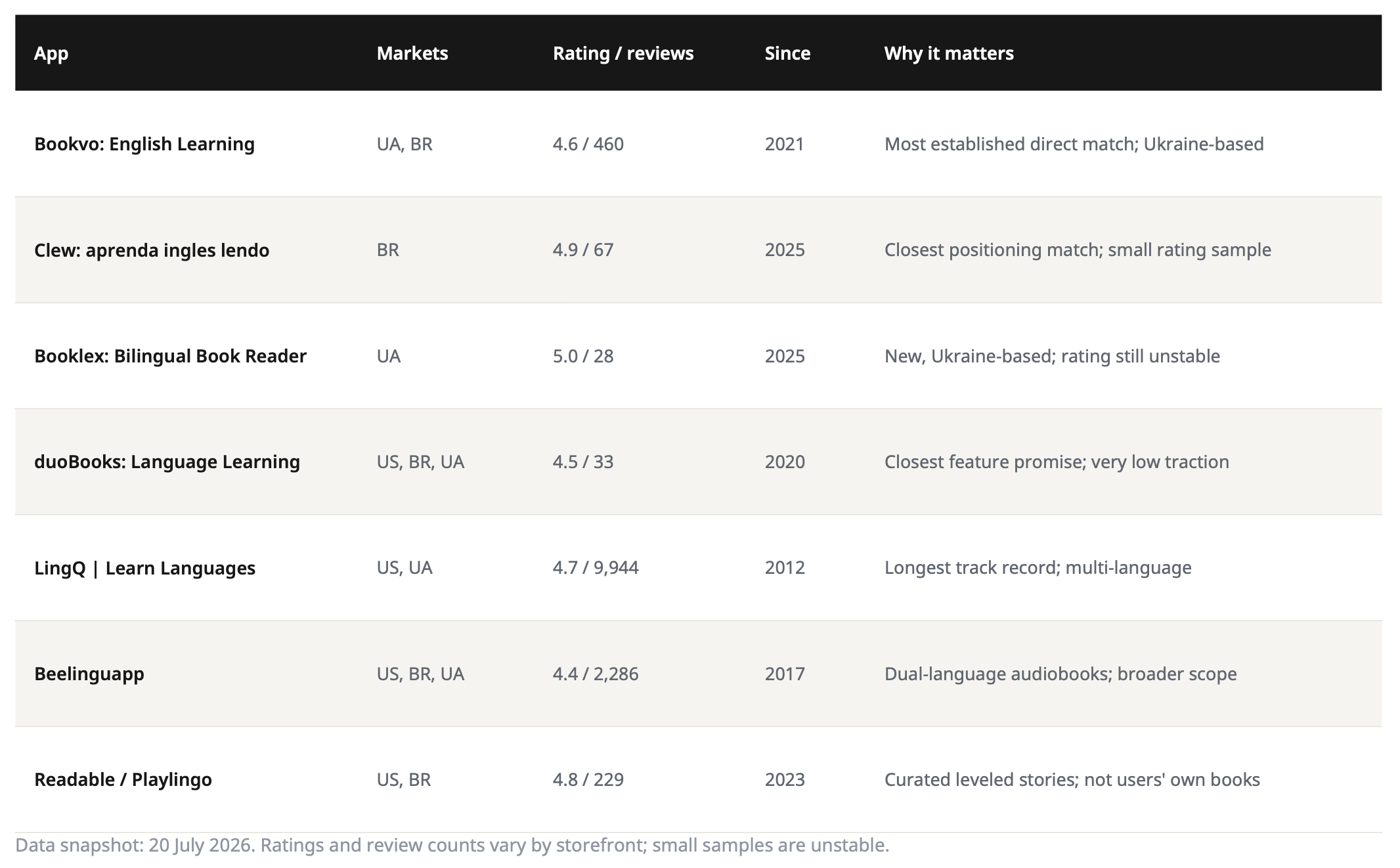
LingQ had about 10K reviews; Quizlet 1M+ and Duolingo 5M+. The niche exists, but no clear reading-first leader emerged.
3. A new wave of launches in 2025–2026.
A notable cohort of new bilingual/graded reading apps. The niche is attracting founder attention but no winner has emerged — there is a window to enter.
4. The end-to-end loop is still distinctive
Among the high-traction competitors reviewed, none combined a user's own reading with tap-translation, saving and later practice.
5. Most competitors use public-domain content.
Beelinguapp, duoBooks, SmartBook rely on parallel-text classics and short stories — not contemporary commercial books. Potential differentiation point — if licensing can be solved.
6. Ukraine already has local players with real traction.
Bookvo (460 reviews, since 2021), Rork (1407, since 2022), WRD (2461, since 2021). The home market is not empty — established competitors exist.
7. Pricing: uniformly freemium/subscription.
Freemium/subscription is the category norm, not a validated Lextorya decision. Willingness to pay still needs direct user research.
Direct Competitors
Apps with the closest core loop: read English text → translate unfamiliar words → save → practise from the reading. Sorted by relevance.
Product Risks
Crowding risk.
Many new entrants in 2025–2026 — Lextorya will be one of several similar products from the same wave, not a first mover.
Discovery risk.
No direct competitor ranks in the top Education/Books charts — the niche is found via search and word-of-mouth, not browse. Strong acquisition strategy required.
Local competition in Ukraine.
The home market already has Bookvo, Rork, WRD with multi-year track records — not a green field.
Content licensing risk (not researched).
If the strategy involves popular commercial books, rights and licensing cost require a separate analysis
Assumptions to Validate
Search behaviour.
Users may use different native-language phrases than those tested.
Business model.
Freemium/subscription is the optimal model for Lextorya. Confirmed for competitors, but not tested against Lextorya's own audience.
Ratings.
App Store ratings are stable for small competitors (Clew, Booklex, duoBooks). A handful of new reviews could shift ratings significantly.
What Phase 1 Changes - for Now
These are current product implications, not final decisions. Each will be tested against competitor evidence and user research.
Protect the core loop
Keep read > tap > save > practise as the MVP backbone. Avoid adding generic lesson features until this loop is validated.
Treat content as a feasibility decision
Do not promise popular commercial titles yet. Compare public-domain, user-imported and licensed-content models.
Use category norms as benchmarks, not answers
Freemium is common, but interviews and willingness-to-pay testing should determine Lextorya's model.
Plan market entry deliberately
Ukraine offers relevant users and local competition; global competitors set the quality bar. Test positioning in both contexts.
In-app UX Audit
PHASE 2
A focused hands-on review of the products closest to Lextorya, using one consistent scenario and evidence standard.
- Install and test 5-8 direct competitors.
- Run the same flow: onboarding > find content > read > translate > save > practise.
- Capture screenshots and observed evidence; separate interpretation from assumptions.
- Read actual App Store reviews to identify real pain points and unmet needs.
- Compare UX patterns, gaps and implications for the Lextorya MVP.
- Update this living case study with findings, changed decisions and open questions.